Tuesday, May 1, 2007

18th Century Clothing - A Historic Communities Book By: Bobbie Kalman


Kalman, B. (1993). 18th Century Clothing. Crabtree Publishing.

Author Bobbie Kalman has found a niche in the ever expanding world of non-fiction texts. She has authored well over 40 books, all dealing in various subjects of science and social studies, which lend themselves very well to using as a read aloud and bounce off point for mini discussions on topics of study in class. Kalman has several “series,” including subject areas such as:

-
Historic Communities
-Hooray for Farming
-My Community and Its Helpers
-Native Nations of North America
-The Science of Living Things
-The Life Cycle


As an interest to my second grade level’s studies of comparing “then and now” in history, and our adjacent status to Colonial Williamsburg, I took particular interest in choosing one of her titles which dealt with colonial times. I like how Kalman uses the key text structures of organizing her books under subject headings, so the reader learns through description about materials that were used to make clothing out of, the wide array of clothing worn by people depending on their social class, types of work clothing, shoes and accessories, underclothing (in which I do not feel deprived because I do not have to wear hoops, corsets, and petticoats! Has anyone ever been in Williamsburg in the summer in any of that? Whew!) Kalman uses key vocabulary terms and has them printed in bold type face, and explains the meaning to these possibly unfamiliar terms. There are also other text features such as a table of contents, an index, photos (many from C.W.) and drawings, which all have some type of captions and labeling. This series is very good to use both for a teacher, who can read most of it, or necessary sections of it aloud to springboard for discussions, and for students to use independently as budding researchers and explorers at the grades 1-3 levels.

Sunday, April 29, 2007

Twisters and Other Terrible Storms - A Magic Tree House Research Guide


Osborne, W. and M. (2003). Twisters and Other Terrible Storms. Random House.

One of THE most popular series of chapter books in my second grade classroom year after year is the Magic Tree House series by Mary Pope Osborne. This fantasy series is enjoyed by children for their fast pace, familiar characters, and fantastic adventures back in time. Teachers like them for the way the children are engaged in devouring book after book, and by the way the fantasy element combines to draw in historical facts about the particular place and time the characters are traveling back to explore. I share a particular one aloud with my students, Day of the Dragon King because the two main characters, Jack and Annie, travel back to Ancient China, and explore time period things such as the way people are dressed, how reading on bamboo scrolls was endangered, the famous Terra Cotta soldiers (accidentally) and have a run in with the emperor Ch’in (aka “The Dragon King.”) If the fire for this series isn't already lit in one of my students, there curiosity is certainly peaked after this read aloud!


Osborne added to the series by creating companion non-fiction guides, each one themed to compliment one of her fiction offerings. The current regular series of books stands at 28, with 15 of them having a corresponding research guide full of facts to further children’s understandings of the history encountered in the fantasy adventure. Some of the research guides highlight the history of the fiction book, such as Mummies and Pyramids to compliment Mummies in the Morning, and some highlight the science aspect of the particular book, such as the one that I am reviewing that I had not yet read entitled Twisters and Other Terrible Storms, which goes along with Twisters on Tuesday. Some of the fiction books are mostly focused on a historical time period, whereas some take place in the past, like Twisters on Tuesdays does, which is during the 1870s, but an element of science is also a part of the story, and thus lends itself to be the focus of the accompanying research guide.

Again, these research guides are a favorite of my classroom library by me as the teacher for several reasons. They are great to use with a guided reading group or a whole class modeling think aloud about how to read non-fiction and how to use the supportive elements such as a table of contents, index, diagrams, and photos. We can also relate what is fact and what is fiction in the story (think also Magic School Bus stories.) I plan on sharing this book with my class as a non-fiction read aloud starting this week, to correspond to our study of weather during our Roots and Shoots gardening program. Students use their listening and visualizing skills, as well as prior knowledge of what things look like in real life and in photos in true books, and can connect to the fiction Twisters story if they have personally read that selection. Some features that I especially like about this particular research guide is:

-the listing and diagrams of weather tools
-important vocabulary written in italics to draw attention to them
-words that may be new to the reader are defined in the margin by Jack or Annie (ex. “The line where a high pressure and low-pressure area meet is called a front.”)
-plentiful diagrams – not just illustrations but labeled drawings and photos are labeled as well
-Jack and Annie “Facts in Action” – points in the book where the reader learns about how to do simple scientific observations (such as how to observe snowflakes or how to tell how far away lightening is from where you are.)
-“Doing More Research” section in the back – where students can find specific sources to find out more on weather – such as particularly age appropriate particular books, videos, museums, CD-ROMS, and Internet sites.

I highly recommend having these in any elementary classroom (grades 1-5.) The focus grades would be grade 2-3, in my opinion, but can find an interested audience in older elementary grades for certain!

Sing a Song of Popcorn: Every Child's Book of Poems


De Regniers, B., Moore, E., White, M., & Carr, J. (compliers) (1988). Sing a Song of Popcorn. Scholastic.

This collection of 128 poems is compiled with a wide array of variety and draws from some of the most well-known poetry authors and children’s book illustrators, and brings together old classics and newer fare within one cover. The treasury is divided into eight themed collections, and each one of the eight sections is illustrated by one famous Caldecott picture book illustrator for all of the differently authored poems within that subgenre section (except one section is illustrated by a married couple together, who also have won a Caldecott for their collaborative work). The eight different sections are entitled:
-Fun With Rhymes
-Mostly Weather
-Spooky Poems
-Story Poems
-Mostly Animals
-Mostly People
-Mostly Nonsense
-Seeing, Feeling, Thinking
-In a Few Words

I selected excerpts from a few selected poems in which I liked the language and how it was played with and what the words provoked me to think about.

From: April Rain Song – Langston Hughes
“Let the rain beat upon your head with silver liquid drops.”

Even though water is colorless, you do see the raindrops, and describing “clear” as a color of them, especially when they are in movement, is hard. Silvery, almost the image of liquid mercury, crosses my mind.

From: Snowflakes – David McCord
“Joints, points, and crosses. What could make
Such lacework with no crack or break?
IN billion billions, no mistake?”

With the appreciation of snowflakes from childhood, as well as from the picture book Snowflake Bentley By: Jacqueline Briggs Martin, I have awe and appreciation of these intricate gifts from nature’s sky in the bleak and grayness of winter. Snowflakes in all of their detail are indeed amazing!

From: The Steam Shovel – Rowena Bennett
“He crouches low
On his tractor paws
And scoops the dirt up
With his jaws;
Then swings his long
Stiff neck around
And spits it out
Upon the ground…”

I love similes and metaphors, and the metaphoric comparison of a steam shovel to the jaws of a prehistoric dinosaur, giving it animalistic qualities, illustrates the might and strength of the teeth of the shovel of this machinery.

From: Lengths of Time – Phyllis McGinley
“Time is particular
And hardly exact.
Though minutes are minutes,
You’ll find for a fact
(As the older you get
And the bigger you grow)
That time can
Hurrylikethis
Or plod, plod, slow.

Another thing I like to see and do with language is to have opportunities to enjoy or write with language in unconventional ways. Here, to illustrate the way time does indeed sometimes crawl and sometimes flies, the author crams “hurrylikethis” to exemplify the speed and bumbling together of events within a day or event where its hard to slow down and comprehend events (and here, words) properly (the first thing it makes me think of is an average school day – they ALWAYS fly for me! I always have so much I HAVE to do, and then there’s also so much I WANT to do with my students!) In contrast, the “plod, plod, slow” actually seems to drag out of my mouth with the sounds of “plod,” like a dull thud falling in the day.

From: Tree House – Shel Silverstein
“A tree house, a free house,
A secret you and me house,
A high up in the leafy branches
Cozy as can be house.”

What child doesn’t love the idea of a secret place to play, daydream, and escape away from the real world (think: Bridge to Terebithia!) Children need a place that’s safe to explore their imagination and outside environment, and even kids need a break from adults. I didn’t have a tree house growing up, but I did have a great playhouse my father built me, with electricity, an old house window in the front, an old crank window in the back from a camper shell (perfect for our “drive through” and secret spy notes to be slipped through!) and a special small sized doorknob. My two best friends and I adored it, especially on a winter or rainy day!

From: Arithmetic – Carl Sandburg
“Arithmetic is where numbers fly
Like pigeons in and out of your head.”
As a person who is seeking a graduate degree in reading, language, and literacy, I apparently have a passion for language (and in my case, a large slant toward the language part of my brain, and less towards mathematical thinking.) I chuckled to myself when I read these opening lines, because I don’t know how many times I felt that’s just what numbers were doing in my math classes in high school!

From: How to Tell the Top of a Hill – John Ciardi
“The top of a hill
Is not until
The bottom is below.
And you have to stop
When you reach the top
For there’s no more UP to go.”

Another thing I like to see in poetry is when something is explained in a creative, matter of fact way. You can’t really argue with it, and the unconventional explanation sticks with you.

Granny Torrelli Makes Soup By: Sharon Creech


Creech, S. (2003). Granny Torrelli Makes Soup. HarperCollins.

In this selection, Sharon Creech has formatted the writing to be spaced out and thus reading the book seems to flow quickly because of the double spacing used between dialogue and paragraph switching. The voice that the story is written is told from the perspective of the main character, twelve year old Rosie. Rosie tells the story in present tense when she is talking with her Granny Torrelli, and in past tense when she is talking about the past, it is typically told in past tense, and rather than cluttering the pages with quotation marks, spoken words are written in italics to differentiate them from the storytelling text. The bulk of the story involves Rosie reflecting with her Granny Torrelli about the current angst that she is feeling with her best friend, Bailey, just a week in difference from the age of Rosie, and have spent their lives growing up next door to each other. Since Rosie is talking to you as the reader, the problem between Rosie and Bailey unfolds petal by petal, with clues leading you to use your skills of inference to realize that Bailey has a sight impairment and this leads to Bailey having challenges that Rosie doesn’t have to deal with in life.

Rosie was hurt with Bailey’s words, “Get over yourself!” which was said “in that cold voice and slam the door in my face as if I am nobody.” Rosie is only seeing her own perspective of this, and it is through her Granny Torrelli’s subtle ways that she comes to understand Bailey’s perspective on the situation. It is done in the kitchen, through the main activity of making soup, or zuppa as her Italian Grandma calls it. Granny Torrelli gently walks Rosie through discussing elements of the problem and her thoughts, and lending Bailey’s possible point of view to the situation. The problem is amplified when a new and very friendly girl named Janine moves into the neighborhood, threatening Bailey and Rosie’s friendship on another level. Grannny also relates to Rosie by sharing about a special friendship that she had with a girl named Violetta and then with a new boy named Marco. In the end, with her wisdom and insight on life, as well as tender heart, leads Rosie to understand Bailey better, and be open to the changes life brings. The story culminates with friends, new and old, with family, enjoying the “fruits of their labor,” the zuppa, which was created while working through problems. This book shows a realistic portrait of friendships between children, still told in a tender way, leaving Rosie as well as the reader to walk away with being reminded of what to cherish and appreciate in life.

Thursday, April 26, 2007

But I'll Be Back Again By: Cynthia Rylant


Rylant, C. (1989). But I'll Be Back Again: An Album. Orchard Books.


As you can see from a previous blog, I had the streak of luck finding Cynthia Rylant's But I'll Be Back Again: An Album at a used book sale at a local public library. They were discarding it (gasp!) and I acquired this out of print book for ten cents! I read it that evening, and I gained additional understanding of this author that has been featured in our children's literature class, and she has also been featured and studied in my second grade classes for each of my nine years of teaching. As an appreciator of Rylant's crafting, I find myself learning more about her style and nuances about her as a person every year, whether it is something I see, or a student interprets about a book at read aloud or independently during a reading workshop conference. I really delved into Rylant's crafting after reading in 1999 Katie Wood Ray's professional resource entitled Wondrous Words. Ray is a BIG fan of Rylant, and she showed me things about the creative ways that she writes that I had not quite noticed before, and that fire was lit in me to think of author's craft with all literature in a fresh way ever since.


In this memoir published in 1989, Rylant writes of different memories of growing up as a child and young teen in Beaver, West Virginia. She includes real photographs from growing up and as an adult, which are in black and white, since there is no color in the interior layout of the entire book. A copy of a letter Rylant received from her father is included. In most of the one page letter, he refers to himself in third person, which I see as a type of detachment. The significance of that letter to her is clear, since as an adult, she still has it. Although not officially in chapters, Rylant has particular stories of a memories as a theme within a section, and these sections are transitioned to new topics with selections of lyrics from Beatles songs. These snippets of songs serve as a preview as well to what lies ahead in the upcoming memories. Besides The Beatles clearly being a favorite of hers growing up, she idolized Bobby Kennedy. Rylant was thrilled when he visited West Virginia, and includes a photo taken of him, and later on in life, she was devastated when she found out that he had been killed. This happened at a transitional age of thirteen, typical of a time when children feel that they are becoming teens, eager to grow up, and internally scared to let go of yesterday at the same time. Within the same year, she lost her father just as he was about to come back into her life after living in out of state. Those events must have made Rylant grow up some, in a way she didn't want to, but had to. I found a passage of hers in relation to this poignant:

"Children can forgive their parents almost anything. It is one of those mysteries of life that no matter how badly a parent treats a child, somewhere in that child is a desperate need to forgive, a desperate need to be loved."

With that selected subject and quote, it is clear that this book is not completely full of happy, lovely memories of a perfect childhood. The opening line of the book reads: "If you are a child who is never told the truth, you begin to make up your own." There are some sad, heartbreaking things that the reader listens to in the text as Rylant writes, and I find myself thinking that this book is not written for a child who is a fan of her picture books. I really find myself feeling like it is written for adults, and could be used with young adults, but not necessarily to study her crafting. This book is more about understanding the roots of the author, her inspirations and challenges, and for the reader to see these influences in books that they have read that are authored by her.

I loved being able to make an text-to-self connection of discovering that Rylant was a majorette. I was a majorette as well (seven first places in VA!) and I still love twirling with my Baton Twirling Club at school. On page 41, I found Rylant's comment about flirting with words with a funny boy named Robert intriguing, because I have used sarcasm more than my fair share in life:

"I think Robert liked me so much because I could match every smart remark he threw my way with an even smarter one. It was my only ammunition with this overpowering boy, and the constant tension between us honed my desperate sarcasm."

Rylant discusses flirting and her first days of being infatuated and curious about boys. She also discusses her struggles to grasp a personal understanding and connection with God, which shows up in several of her books, including Waiting to Waltz. She also discusses how she feels she became a writer:

"They say that to be a writer, you must first have an unhappy childhood. I don't know if unhappiness is necessary, but I think maybe some children who have suffered a loss too great for words grow up into writers who are always trying to find those words, trying to find a meaning for the way they have lived."


Writing has clearly helped Rylant deal with unresolved issues from the past, explore pleasant memories, romanticise her favorite times as a child, and create happy experiences for younger children through her picture books.

As a related text, there is a series of "Meet the Author" books (published by Richard C. Owen, Inc.), and one of the selections is indeed written Cynthia Rylant entitled Best Wishes. It IS written with younger children in mind, and is readable to a class to provoke connections and discussions. The book includes color photos on each spread of Rylant and her current home at the time in Kent, Ohio, as well as photos of the humble homes of her Grandmama and mother. You can see she's a real person, quiet and sometimes perhaps a loner when entrenched in thoughts of creativity. To see photos of her standing at a famous scenic spot in West Virginia where I past by during Spring Break was neat as well. A recommended quick read for teachers and to share with your students as well.

Thursday, April 19, 2007

The Seashore Book Written By: Charlotte Zolotow and Illustrated By: Wendell Minor

Zolotow, C. (1992). The Seashore Book. HarperCollins.
In the picture book The Seashore Book, written by Charlotte Zolotow and illustrated with paintings by Wendell Minor, the story starts out with a little boy at home with his mother in the evening as the sun sets on the mountain behind their tidy white washed house with welcoming lighting seeping through the windows. The boy asks the question, "What is the seashore like?" as the first line of the book, and the mother begins to describe it to him, since he's never been there and only knows of the mountains.
The book continues with the mother explaining and describing, and the illustrations that accompany each page portray what she is describing, with the little boy incorporated in the pictures, echoing what he must be imagining in his head while the descriptions his mother is giving unfold for him. The paintings of gouache and watercolors are realistic in tone, depicting the nature, animals, surf, sand, and skies that surround him in his visualizations that his mother is "painting" for him, helping something so foreign to him come alive. It's an interesting side note that one of the three places that the illustrator enjoys spending time painting the seashore is on the Outer Banks in North Carolina, or "the beach" as locals around here in Williamsburg refer to it.
The mother's descriptions help him to not only see the scene, but smell, feel, and hear it as well. It she describes what it would be like to be at the beach for the day, and she describes how the day changes as the sun comes up, then is later overhead in the noon heat, and later on begins to set. Zolotow's prose is lyrical and inviting, and the book invites itself to be a favorite before bedtime, with a calming, peaceful effect.
There is so much to admire about the use of language to describe in this book. A few of my favorite descriptive lines are:

"The cold water makes your skin feel like peppermint, and you are tired."

Describing the noonday sun:
"...it feels warm as a big soft cat covering you, taking away the chill of the waves."


Describing the lighthouse in the evening:
"Outside, the lighthouse is flashing


golden gleam on


golden gleam gone."


This book lends itself well to lessons on visualizing, especially to have students only hear it the first time through, with an additional reading or a showing of illustrations after the first reading. Predicting is intertwined with that practice of visualization, making good guesses about what is in the picture, based on what what specifically stated, and with the use of inference, what could also be in the picture while they are not seeing it. This book is a great teaching tool as well as a bedtime treat between two loved ones!


Joyful Noise: Poems for Two Voices By: Paul Fleischman

Fleischman, P. Joyful Noise: Poems for Two Voices. HarperCollins.

I enjoyed reading the collection of poems entitled Joyful Noise: Poems for Two Voices Written By: Paul Fleischman and illustrated with finely detailed pencil sketches of insects by Eric Beddows. This book was honored with the Newbery Medal in 1989, and it is clear that the inventive crafting of Fleischman won him the distinguished prize. On the back of the book, as well as in the interior prior to the first poem, the reader is instructed to read the poems with a partner, and they are better enjoyed by sharing them with some type of listening audience. Sometimes the person to the left reads a line, sometimes the person to the right is doing the reading, and on other times the two people read them together. For two people to do this, the poems must be read aloud, and that is an innovative format to write in.

I relish in coming across unique metaphoric comparisons, and similes that make me see connections that I had not thought of before. My favorite comparisons are found in the poem Fireflies:

"Light Light
is the ink we use
Night Night
is our parchment"

and at the end of this poem:

"Six-legged scribblers Six-legged scribblers
of vanishing messages
fleeting graffiti"

I thought the poem entitled The Moth's Serenade was humorous, with the moth conveying his undying longing for the porch light, finding it irresistible, as if madly in love with the woman of his dreams! I see that on Fleischman's web site, that he has two versions of "The Moth's Serenade" that people have composed in a music format, paying homage to this poem! In the poem Cicadas, merely hearing of that insect reminds me of that all too familiar sound in the trees of Tidewater, Virginia in the irrepressible heat of July and August. I especially like this line:

"Air kiln-hot, lead heavy"

Hearing that reminds me of stepping out of an air-conditioned space, and having your breath sucked out of you, either by the dryness of the heat, or the wet, heavy, humidity in the air, both making breathing a big more tasking.

I look forward to sharing some of these poems with students in my class in the near future! The poetry in this themed collection are a perfect compliment to our insect studies and upcoming Bugz 2nd grade play in a few weeks, where my class will be a hive full of bees - with kazoos! It's important to do some different things with students this time of year, to take a break from the everyday hum drum routine, to keep the students engaged and excited to come to school each day. The format of these poems is just the type of new novelty to bring to my students, and the challenge of reading in a different format, along with working with a partner, is the type of engagement that students forget that they are learning a host of skills, because they're having too much fun!

Long Night Moon Written By: Cynthia Rylant and Illustrated By: Mark Siegel

Rylant, C. (2004). Long Night Moon. Simon & Schuster Children's Publishing.


I recently read another selection written by Cynthia Rylant entitled Long Night Moon. It was illustrated by Mark Siegel. Rylant’s writing is true to her craft in that she doesn’t feel bound by traditional writing styles or more common grammatical usage of words. The placement of the text on each full page spread is thought out, so it does not interfere with how the illustration communicates to the reader just as the words themselves do. The flow of the book truly begins on the initial end pages. So the growing flow of the opening tone of the book’s story is uninterrupted, the page with copyright and official book information does not appear until after the story is told by being placed in the back of the book.

There is a playful version of cursive font used in the text, almost to set a scene that this was written by hand onto the pages, homespun like an orally told story that is passed on to generations to seek meaning in. The story is actually told as originating from the Native Americans who named each full moon a particular name, fitting to the time of year and season. The color of the font itself is in various pastels to compliment the text and spread's main idea. Each month has a particular name for the moon, which is highlighted with a contrasting, bolder pastel colored text to emphasize its presence. Names of the moons include, “Strawberry Moon” for June, “Harvest Moon” for August, and “Thunder Moon” for July. The few lines describing the moon on each page spread is sparse, but in classic Rylant crafting, paints a visualization that starts with the illustration on the page and comes alive with the particular selected words, with their spacing and line skips punctuating and pausing the reader’s rate of reading. A wonderful example comes from July:

“In July,
the Thunder Moon trembles
shudders,
and disappears
in a thick black sky.

It listens to the
clouds
Beat their drums.”

I saw on a website called kidsreads.com a letter that Cynthia Rylant wrote for the site that’s posted to read. In it, she discusses a variety of things about herself, things that she likes in life, and she goes on to mention how she enjoys creating the text for picture books. “I especially love writing books that are illustrated. They are so beautiful to see, the paper is so nice and shiny, the colors so beautiful and rich. Picture books glow in your hand, and they never get boring (if they are done well).” Having that prior knowledge of Rylant’s viewpoints, I thought of that particular quote as a read through Long Night Moon. The text figuratively and literally has a glow to it, thanks to the soft moonlight. Even though the entire book is in a rotating scene of darkness, light resonates from each spread’s full moon, and illuminates text's specific touches throughout the layout. The light punctuates the darkness, and gives the reader a safe feeling simply by the softness and light provided by the moon.

The illustrator, Mark Siegel, uses his artistry with light in the pitch darkness to tell the story on each page. The illumination from the moon plays upon the scene below, which is really just a continual rotation of the same scene, the reader "moving" in an orbit just as the Earth does during the course of a year with 12 full moons. I found it interesting that after I googled Mark Siegel's name and went to Wikipedia, there was the cover of Long Night Moon with a few other picture book covers that he drew, but that the style of the other covers were in a very different, more graphic cartoon style. It said in the text that he is noted for his work with creating graphic novels for all ages, which are really more lengthy comic books. The art Siegel created for Long Night Moon is clearly uncharacteristic of his usual and favored method of illustrating. What was especially interesting was his note in the back, at the top of the book informational sheet entitled, “The Adventure of Illustrating Long Night Moon.” In it, Siegel discusses how he was drawn to Rylant’s writing, and struggled to find what he felt would be the best medium to draw with. After experimenting with several mediums, Siegel still wasn’t satisfied. He began to take evening walks on a country farm and made himself take in the nature around him. It’s truly moments of “stopping to smell the roses,” to jump off the Ferris wheel of life and really take in the complexity of nature. Once Siegel did that, he opened up to what he should capture about the moon. While exploring mediums again, he found that charcoals captured the moon: "It returned me to that velvety mysterious light that softens everything, bathing nature in a dreamy luminosity.” When I read that, I thought about how I was really intrigued to hear about the illustrator’s train of thought process to interpret an author’s words, to give them the right justice and express the author’s lyricism and feelings on their behalf with their own artistry entwined. Sometimes authors discuss their motivations and inspirations for stories, whether in an author’s note in a book or in an interview, but it is rare to hear the illustrator’s point of view. That was intriguing, especially since Rylant’s works are illustrated by numerous artists.

I couldn’t wait to use this book with my class this week! The text is short, and to an average kid, they would have independently flipped through the book in no more than ten minutes. At this point of the year, my students are at that wonderful time of year that they talk “book talk” and get the big picture and all the details that go along with it! When I began to introduce the book, I didn’t even have a chance to say who the author was, because one of my keen kids saw in the small script on the cover, “This is a Cynthia Rylant book! I haven’t seen that one before!” I love the fire these kids have not only for books, but for the stylings of favorite authors, knowing that if they have savored selections from them before, that they are most likely in for another enjoyable journey. My kids were into it the moment I opened up the the initial end pages, and I let them chat to a neighbor about the setting and what they thought the book would be about, because they were buzzing with curiosity after I read the interior flap of the cover and turned to the title page.

After letting a few partner pairs share briefly with the whole group about their predictions, I began to read. When I got to the first page of text which states that the Native Americans gave names to each full moon, they chatted to revise their predictions, and shared with the class that they thought each spread would be for a month and the name would fit the month’s weather and season. A student also commented that they noticed the same gazebo in the three pages so far, and that we were zooming closer to it, and that its place on the page spread was moving. At this point, I thought to myself, I wish this was being videotaped! These children were getting concepts some adults wouldn’t pay attention to! Another noticed that the zooming up reminded them of when we read Rylant’s Scarecrow back in the Fall, when we were first studying Rylant’s writings. A neighbor noted that he remembered how we zoomed up close and far away for our individual illustrations of scarecrows that we did to go with their poetry in the hall showcase.

We discussed with neighbors and sometimes as a whole group each page spread. They noted things such as the words she chose were the main ideas of what was shining with light in the pictures, and that it fit the season and time of year. A partner pair caught on as the big tree moved in location on a sequence of spreads that it was like we were standing in one spot, just turning around with slow steps to observe different parts of the very same place. That’s when I explained that they were indeed right, and I had one student stand up and turn in a 360 degree manner, and we’ve reference that all week for fun in class. Students noticed how the moonlight glowed on the nest of baby birds, how the wording and light on the “Strawberry Moon” spread for June was pink, echoing the pinkness of the inside of a real strawberry. They also discussed with partners how in real life when the moon is closer, you can see the craters and ruts just like they could see in the “Acorn Moon” spread. One student also mentioned that the light coming from the window of the little house was warm and welcoming, and that it made them feel safe.

Before I knew it, a book that I thought might take my bright group 15 minutes to enjoy had bypassed 35 minutes. They were engrossed in the book, and I was engrossed in their ideas and observations. I was so proud of them! They get it! At this time of year, it makes me eager to share more than one book a day (when I can) with them, for they are as ravenous as I am when it comes to exploring great books! What fun!

Check out Cynthia Rylant’s letter at Kidsreads.com:
http://www.kidsreads.com/authors/au-rylant-cynthia.asp


Here’s the entry on Mark Siegel on Wikipedia:
http://en.wikipedia.org/wiki/Mark_Siegel

Sunday, April 8, 2007

My Travels Through the Town of Beaver: Looking for Rylant's Waiting to Waltz Roots


Rylant, C. (1994). Waiting to Waltz: A Childhood. Simon and Schuster Books for Young Readers


Waiting to Waltz by Cynthia Rylant is a collection of thirty short, free verse poems, each one encapsulating a memory of a vignette in her young life. The pictures are drawn by artist Stephen Gammell, are sparse and impressionistic in their black sketchings, romanticizing the vignettes that are shared about people, places, and memories of Rylant’s childhood. This poetry compliments her memoir in their autobiographical point of view, and of their own memories.

Having read Cynthia Rylant’s memoir But I’ll Be Back Again I come to this book of poetry with some background knowledge. I know that she grew up in the Appalachian culture of West Virginia in a town called Beaver. The book opens up with a poem entitled “Beaver.” I liked the lines that follow some descriptions of a simple country town:
“Beaver Creek holding it all together,
And me on the edge,
Like the water, muddy and rolling.”

From the poem “Wax Lips,” I can see Rylant’s hinting of flirting as a young child that I read about in her memoir:
“and walked the streets of Beaver,
Our teeth sunk hard in the wax,
And big red lips worth kissing.”

In the poem “Holiness,” I again hear echoes from her memoir, where you hear that she struggles somewhat with her understanding and view of what God means to her. In this snapshot in the poem, she recounts her Pentecostal babysitter, who is boisterous at church, and it seems like the rambunctious way of praise adds to her confusion and resulting intimidation of religion as a child.
“And on the church bus back
I looked out the window, away from her,
Because I didn’t understand
Such noise
And was frightened
By God.”

In the poem “The Rescue” she tells of once when she guided a younger girl home that she comes across because she is frightened of the oncoming storm that they already could hear the cracking thunder of. A full page bleed of the endless field and house is portrayed when you turn the page, emphasizing her need to find internally a source of braveness in a seemingly very lonely setting.
“I turn around
And walk in the storm
Slow and straight,
But inside,
A little girl crying.”

Although not emotionally charged, the memory Rylant shares in “Band Practice,” which once again echoes from her memoir about being a majorette. As a side bar, I was a majorette, and I still twirl today with my Baton Twirling after school club for girls in grades 3-5 at Matthew Whaley. I call it my “secret talent,” although I don’t know why I bother because I am “famous” for it. ;) I don’t know what possessed me to overlook the fact that I was tossing a steel rod in basically a 300 dollar sequined bathing suit, but I loved it. High tosses, two baton, and even fire baton for Homecoming halftimes. I like how she ends it:
“Forgot a lot about playing
Trumpet.
Learned a lot
About
Playing.”

The source of the book’s title is within the poem “Teenagers,” where she talks about that transition time where it’s a fuzzy line between being a child anymore, and when can she hurry up and be a teenager with all of its trappings, the kissing, dating, using makeup, and such.
“Waiting to shave
And wear nylons
And waltz.
Forgetting when
I was last time
A child.”
Never knowing
When it
Ended.”


During my Spring Break this week, I traveled through West Virginia on my way to Ohio, and before leaving, I mapped out my journey and wrote down directions to follow along the way. When I looked near the town of Beckley on the map, I realized that Beaver was located nearby. Even though I had a ten hour road trip ahead of me, I knew I had to at least take a quick tour of the heart of Beaver. I couldn't come so close to Rylant's roots that have inspired her writing so much and not a least take a good peak. It's located near a major town of Beckley, which has become a big tourist pit stop, and so I am sure that has had quite an modern influence on the town of Beaver. I did take the main exit for Beaver and drove to a "big part" of town, where your typical off the interstate fast food restaurants and mom and pop eateries are located. There were several churches around, and you could tell that this was located in the Bible Belt with the church signs and such. I wish I could have known where her childhood home was, or if I was near the stores and church she spoke of, but I at least got a quick feel for the rural West Virginia old homes and farms that dotted the road to the shopping center and places to eat. I have included some photos I took of the interstate sign, the nearby mountains, and the "Beaver Creek" antique store, a place where I am sure it holds onto the memories of a town of yesterday. Enjoy!

Sunday, March 25, 2007

I Had Seen Castles By: Cynthia Rylant

Rylant, C. (2004). I Have Seen Castles. Harcourt.

In this novel for older children, Cynthia Rylant writes from the perspective of John Dante, a man who is in his 60s and is reflecting upon his young years as a soldier. He lives in Toronto in his mature years, but the bulk of the story is spent reflecting upon the years of his youth becoming a young man in Pittsburgh. As a boy going through the normal growing pains of feeling the need to prove his manhood, he felt an especially strong patriotic fever to stand up for his country, refusing to be seen by others, especially other men, as weak or a coward. There’s a conflict of emotions, about the war itself with John and the girl he loves, Ginny. One of the things that makes him feel like he has stepped into manhood is that he was able to be with Ginny, and that upon first becoming a young soldier, he felt it gave him a more mature edge over the others in his mind. Within that disagreement in mindsets, the realism of war strips away the dreaminess of falling in love and from everyday life itself. An intensity sets in with John, about how he feels even stronger about Ginny and wanting to take and protect her from her run down, poorer life, about proving that he is a man among men to society, and within the patriotic fervor that he is caught up in as Americans were at the onset of the war’s encroachment onto American soil.


The book is a rather brisk read. Despite the given subject content’s extreme weight, the book is not heavily laden with so much extra activity as it easily could fall prey to. Rylant manages to keep the story sparse, to allow the story to focus on the mental conflict brought about by the war that due to the lack of closure with Ginny, John can never really truly shake the impact and adverse affect the war had on him the rest of his life. He talks about how it was hard to live in America after the war, and couldn’t be jubilant upon the end of the war as the rest of the greater U.S. population was, because they had not seen the suffering, blood, destruction, and gore that he had been saturated with while overseas fighting. He lived in France for 20 years, then in England and Greece, ending up in Canada. John never shook the horrors of war that stole his optimism and innocence, and even above that, never shook his endearing and sincere love for the embodiment of innocence, the young love he had in Ginny. Even though the story is not heavy with overdescription, it tells of powerful sentiments in its simplicity.

Some of the powerful phrases and lines from the story include on page 2: when he is comparing his home to “a soft-smelling grandmother” and that the worn oak floors “announced the life of the house…floors that sang.” I also liked how on page 3 he described his father’s selection of books in his library which reflected his interests and taste: “Words to bind you to this room, this house, this planet. Words to make sense of everything.” I like how he recognizes that “Children, without the skills of language, spend years developing instead an intuition” about their parents. Another true observational point he makes is how boys horseplay to show affection to one another on page 7: “the banter, the wisecracking, the cuffing and the shoving that boys must do to claim ownership of each other.” How often do we see grown men do that today, around sports, a car, a card table, etc.? Yet another behavior observation he makes quickly is when he is describing on page 10 college students biking around town, and that they “are open like flowers” so meaning they are fresh in bloom and bright and bold in their color. He makes a powerful observation when on page 16 he states that people “deceive ourselves into believing we can clean up the enemy, put him back in his place…” while still going about the normalcy of daily life after hearing of the obvious upset that the turn of the war has brought to their lives.

Another point he makes on page 19 is that “Love in those times was nuts. Not artificial, not ridiculous. No, it was so real to be completely heartbreaking. But it was nuts all the same.” This exemplifies the intensity the realness of life then set upon his already intense feelings for Ginny, and how that was never again felt by him in his life. Another point about the intensity of bonding between people echoes his need to feel like a grown man, and the bonding between men that is not easily expressed amongst them, where on page 75 he states: “And there was an intimacy among us, there on the front line, that no soldier working behind the lines would ever know or understand.” It reminds me of the 9 part mini-series Band of Brothers that I watched with a group of friends, and the guys were so into it, relishing the bond the men in the real story had. It also reminds me of my Grandpop Fox, who was one of five brothers in a family of twelve kids who were old enough to serve in the Armed Services and did so. After two of the sons (my great uncles) were killed in combat, the others were sent from the battlefields to work behind the lines. I have a copy of a local newspaper clipping that shows my great granny Fox being acknowledged as a Gold Star Mother, and I have made rubbings of their names from the York County granite memorial statue for hometown fallen heros. My mother has a letter he wrote his mother (my great grandmother) and to hear my grandfather who I had known as docile and sweet hearted to be so bitterly angry about his brothers’ deaths and wanting so bad to be back out there to pay back for their deaths was deeply real and intense to read. I thought a lot about my Grandpop Fox while I read this book, being that is my closest connection to the text, and I understand a little more why he never really discussed the war too much. Despite the serious and heavy subject matter, I did enjoy the book for what the storyline brought to my eyes about a generation other than my own.

Friday, March 23, 2007

Seedfolks By: Paul Fleischman


Fleischman, P. (1999). Seedfolks. HarperTrophy.

This book is centered on the creation of a garden in a diverse, urban Cleveland neighborhood vacant lot. The format of the story unfolds within the thirteen chapters, each one focusing on the first person voice of a character that lives in the neighborhood and begins to interact with the creation of the garden. I found this setup of the book to be interesting, because it gave me the opportunity to hear each character’s diverse perspective as the way that each chapter was written as if the person was telling their story. Each character’s voice was clearly distinctive, as their dialect and use of grammar, whether proper or not, was written in their particular way. I could clearly hear the characters, and I felt that with the characters’ tellings, I could better picture them and even bring to life a tone of voice, whether high or deep, soft or hard.
In this book, the story begins with Kim, a young Vietnamese girl who desperately wants to connect to her deceased father that died when she was eight. She finds the courage to plant six beans in the harden Earth that was trying to break free into spring, hoping that her father looking down would see that she knew what persistence she had to care for plants as he had as a farmer. The book moves on to Ana’s story, who describes the diversity of nationalities in the neighborhood throughout the years. She then proceeds to tell how she saw Kim from her apartment, and suspicious that she is up to no good. Ana goes out and digs out of burning curiosity, and begins to dig up whatever the girl buried, only to discover she was digging up seeds. I thought the line she spoke was powerful: “I felt like I’d read through her secret diary and had ripped out a page without meaning to. I laid those beans right back in the ground, as gently as sleeping babies.”
The next character is Wendell, who lost his son to a shooting and his wife to a car wreck, and keeps an eye out for Ana. Ana employs him to go water the beans that she sees are dying from her binoculars. As a farm boy, he maneuvers an old refrigerator to reflect heat down, and mounds soil to support and catch water around the seedlings. Kim witnesses this, and fearful, says nothing. Wendell reflects on the Bible phrase: "And a little child shall lead them.” This reverberates that the initial chapter on the little girl Kim, young and able to be a visionary, unencumbered by the weight of adulthood, changes the lives of those who begin to interact with the garden, and out of the rest of the remaining nine stories, the domino effect of Kim’s bean planting unfolds into the mutual bonding between neighbors into a community.
This book flowed rather easily, considering that there was a shift in tone and voice with each new chapter since there was a new character introduced to the mutuality of the garden’s growth. I liked how they were distinct, but yet interconnected, and that the interconnectivity grew from the innocence and goodness of nurturing living things. In the end, it was not only plants that were nurtured, it was also people.

Monday, March 19, 2007

Raising Dragons Written By: Jerdine Nolan and Illustrated By: Elise Primavera

Nolan, J. (1998). Raising Dragons. Harcourt Brace.


Author Jerdine Nolen visited our school last year, and she gave a wonderful presentation via the LCD projector showing her thought processes and project development. She is someone who solely writes, and her books have been illustrated by a variety of people, so there is no distinct “Nolen” look to a book, similar to Cynthia Rylant’s many book selections. I particularly like how the end pages of the book give an additional hint to the fantasy that is about to unfold within the text of the story, by drawing a map of “Dragon Island” from “Murdoch’s Adventure Atlas of the Known and Unknown World.” Even the shades of color and speckling of paint give it mystery and substance that draws the curious reader into the setting.


In this particular story, a little girl lives on a farm with her Ma and Pa and discovers a mysterious egg. Although her Pa forbids her to bother with it, she finds that on a sleepless night when she goes to check it out again, that a little dragon was born from that egg. I find it endearing when she decides she loves him at first sight.

Hey there, li’l feller, welcome to the world,” I sang, soft and low. As I stroked his nose, a sweet little purring whimper came from him. As I touched skin to scale, I knew I was his girl and he was my dragon. I named him Hank.”

This is one of those stories where the child, as the main character, approaches a situation with wide open curiosity and embraces the new situation with a positive, happy response, while the adults go through fear of the unknown, then choosing to ignore the presence of this creature that has interrupted life as they have known it. The special bond continues to develop between the dragon and the girl as he grows in size. The value of the dragon’s help begins to surface as Pa notices a “strangeness” occurring around the farm. Hank has shown he can pull his weight by plowing the fields as a surprise for Pa, and saves Ma’s tomatoes from drying out by fanning them to keep them cool. It’s through these actions that Ma and Pa come around to appreciating him. Later on, Hank helps to pop a multitude of corn into a sky full of popcorn. What kid wouldn't want to be a part of that illustration in real life?
As he grows up, the little girl realizes that it’s best to have Hank live with his own kind where he originates from, and bids him farewell. Before her departure on the plane, Hank loads a wheelbarrow full of eggs for her to take back and nurture on the farm. I like the line, “His toothy grin lit up that cloudy day.” It gives the sad moment a happy ray of sun that leaves the reader satisfied for all involved in the story as it continues beyond the end of the text.

The Patchwork Quilt By: Valerie Flournoy and Illustrated By: Jerry Pickney

Flournoy, V. (1985). The Patchwork Quilt. Dial Books for Young Children.
Coretta Scott King Award for Illustration - 1986
This story is about a very special and loving family relationship between a granddaughter and grandmother. The main purpose of the story is that the grandmother wants her granddaughter Tanya to gain an appreciation for things that are hand crafted with love. I felt the warmth of the grandmother and granddaughter relationship right from the beginning of the story. I automatically made a text to self connection to their relationship to the special relationship that I had with my Granny Fox. She was an avid sewer and antique doll restorer, and along with my mom crafting and my Grandpa Fox work working in the shed, I was surrounded by crafty people nearly every Sunday in Yorktown. I remember when I was a young adult in college, my Granny’s MS set in more and more, and she began to feverishly make small sewing projects, from doll size quilts to patchwork pot holders. She knew she was losing her ability to be nimble and gifted with her hands, and wanted to leave her mark through sewing as much as she could. I thought about that when Tanya’s grandmother became ill while in the midst of a long term quilt project, and I knew how Tanya felt when she knew that she needed to carry on the project, as part of handiwork skills that must be practiced and past on from one person to another, to someone who cares enough to be dedicated to the meaning of the task at hand.

I thought of Tanya’s quilt the same way I thought of my Granny Fox’s projects, as pieces of love that have permanence. I liked how the author brought out the points about how she reused different, worn fabrics that truly were snapshots of memories in old things, and it states, “A quilt won’t forget. It can tell your life story.” Instead of having to completely give up a favorite pair of pants, for example, grandmother can still squeeze out a permanent memory from them by cutting them up for patches. I still have my Granny Fox’s pot holders in my tea towel drawer in the kitchen, and I know the origins of some of those pieces of patchwork. My favorite cloth in the patchwork was leftover pink gingham from where she made a dress for a bisque antique doll that she made me as a young girl. That fabric resurfaced 15 years later in that particular pot holder of mine, and although I don’t use them because I don’t want to mess them up, a permanent piece of her is in my kitchen, along side the jelly cupboard my Grandpa Fox handcrafted for her years ago. As for Tanya, I was relieved when her grandmother recovered, so that way the message of the story is conveyed to children without being scary or too sad. A touching, peaceful story that spans generations.


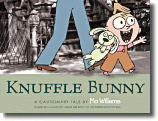
Knuffle Bunny By: Mo Willems

Williams, M. (2004). Knuffle Bunny. Hyperion Books for Children.
Caldecott Honor - 2005

I like how the book displays “A Cautionary Tale by: Mo Willems” on the front cover, because that intrigues me to know what mischief will unfold within the cover for me to learn a life lesson from. Mo Willems illustrations are funny and appealing to both a child’s perspective as well as to an adult perspective. I think of the goofy spin on the simplistic, cartoonish drawings on top of real black and white photo settings punctuate the emotions throughout the story. The child Trixie (how fun is that name?!) is hugging the bunny so hard in the first Laundromat picture that the bunny’s eyes are bulging and his appendages are swaying to the extreme left. The “photos” of his family, one with him screaming his head off after being born to a whipped looking pair of proud parents, to the way the baby is squished and oozing out of the kangaroo pouch baby carrier is hilarious! I laugh at Trixie swinging her mom’s bra around in the Laundromat, although in class I would not be drawing any attention to that.
I love how the sheer look of panic sweeps over Trixie as she realizes that her precious Knuffle Bunny is missing. When she tries, in her garbly baby talk to tell her daddy, his oblivious reply is “That’s right. We’re going home.” The illustrations are adorable and so funny for both an adult and a child while they share the book together. When Trixie goes limp and “boneless” then “bawled” to express herself, you are definitely given her perspective of being a frustrated kid who can’t communicate her needs! Each page makes me laugh, including her “Uh, Hello!?!” look she gives her dad when mom asks “Where’s Knuffle Bunny?” In the end, they find it and Trixie’s first words are indeed “Knuffle Bunny!” Appealing for a quick read aloud to Pre-K through First Grade, although my kids in Second Grade would still giggle at it!

Mr. Mumble By: Peter Catalanatto

Catalanotto, P. (1990). Mr. Mumble. Orchard.

I have had the fortunate opportunity to hear and see author and illustrator Peter Catalanotto as an author in residence with his visits to my school. His illustrations are realistic, with a touch of his own style of impressionistic lighting. The story is about a man named Mr. Mumby who is coming down with a cold at the onset of the story. As he prepares and travels through a typical day, the people he encounters are all misunderstanding him. The first misunderstanding is where is title is derived from, when he picks up the phone, and says his name, and the person on the other end of the line says that she is looking for Mr. Mumby, not Mr. Mumble. I can see Kindergarteners and first graders giggling at the antics as they unfold, especially when they are ramped up when he is at a diner and orders “two scrambled eggs and a corn muffin,” but is instead served “two scarecrow legs and a car muffler.” This certainly illustrates how important it is to communicate effectively in order to get what you want or need! Then, the story stops telling you what he meant to say, and the reader is led to independently figure it out by reading what he asked for, but seeing what he actually got in the illustration (for example, “a can of stew” yields him a kangaroo in the grocery store.) I would definitely have to guide students to figure out what a “haberdesher” does, since most children would not have any idea what that is. They could use the context clues in the text, “…and the haberdasher handed him a muskrat when all he’d said to the man was he needed (cough) a new hat…” Children love the opportunity to be empowered to be problem solvers and word detectives.

Jam and Jelly by Holly and Nelly Written By: Gloria Whelan and Illustrated By: Gijsbert van Frankenhuyzen


Whelan, G. (2002). Jam and Jelly by Holly and Nelly. Sleeping Bear Press.


The cover illustration of this picture book is rich with realism and warm tones of color. I was pulled in by the cover and then I saw that it was also a VA Young Reader Selection, so I knew that this book was a selection to peruse. I am struck throughout the book how the light is played upon the scenes and characters, and I find that I feel connected to the characters simply because they are initially inviting via the painting technique from Gijsbert van Frankenhuyzen. The pictures compliments the lyricism of the written word of Whelan, who herself is a poet by nature. The text written by Gloria Whelan is rich with sentences and phrases worth remembering, such as, “Hunkered down under the braken fern I’m eye to eye with a daddy-longlegs walking on stilts and a green beetle so shiny he looks like he turned a light on inside himself.” The story is about a little girl named Holly who lives in the northern part of Michigan with her family. The setting is gorgeous throughout the book, everchanging to show nature’s splendor. Whelan’s description compliments the detailed and realistic pictures, and makes me hear and see the action unfolding. Holly and her mama enjoy the summer and collect berries throughout the season to make a variety of berry jams and jellies. The simplicity of living off the land and appreciating nature is emphasized in this story’s tone. In the end, her papa has built a surprise for them, which is a stand to display and sell their jams and jellies in the fall. She sells them all, and in turn, can get a coat and boots so she can attend school during the harsh winter and so she won’t have “big holes” in her learning like her mother. Education is valued, and through persistence and hard work, she earns money for the much needed items. The story closes with, “What keeps me warmest of all is remembering the smell of strawberries, the busy river, the raspberry pie, the colors of blueberries, sleepy bumblebees, and Papa’s surprise.” This sums up the passing of the seasons and the course of the story in a lovely way. I think that this story would be wonderful to read to a generation who doesn’t take the time to notice the simple, free things in life as much as generations in the past had to in order to survive. I will be sharing this with my class!

Saturday, March 10, 2007

Ah! A snapshot view of bookcases in my life! :)

An "ariel" view of most of my classroom library. (Yes, I was standing on a desk after school. ;) I couldn't fit all of it in a frame and it doesn't show the chapter book nook or my teacher shelves that are double stacked (in the front and in the back of the shelves.) I pull from my teacher shelves during the year for read alouds,
thematic SOL units of study related non-fiction, and for special books like author signed additions. My mom has taught me how to be quite the scavenger, and between garage sales, discarded shelves from friends, family, old store displays, and even the curb, I have accumulated quite a hodge podge of shelving and display units! You can also see the social studies center counter, which is currently displaying China related objects along with non-fiction resources and related fiction literature trade books. :) My newest acquisition are the two tall cream color bookcases (you can see one of them, with the animals on top.) They came from a store that went out of business and once upon a time they housed Ty Beanie Babies. However, they are sturdy and go up, up, up! When you can't go out, go up! Good thing I have a tall ceiling! (Hmm...maybe we need one of those cool library rolling ladders? A girl can dream!) My good friend and team mate has her class right below me, and we have joked more than once about how we wish we could expand our classrooms where the courtyard lays outside of our windows. Then we would make a "world class" classroom library with lofts, welcoming seating, a twirly staircase in the middle to go from her room to mine, and how we would need a computerized library checkout system. I know, we have creative imaginations! However, in reality, it is important to keep a real classroom library at a size where it is not overwhelming to help students make "just right" choices from a quality collection of fiction and nonfiction genres of trade books. It is also important to explicitly model how to use the library effectively and effeciently, and it must be well organized. I feel strongly that it's important for students to feel that they have a responsibility to care for the books and to love using the library to its greatest potential. It's all rooted in the desire to create an enriching atmosphere and tone for our students while in our classrooms!


Wednesday, March 7, 2007

Van Gogh Cafe By: Cynthia Rylant

Rylant, C. (1995). The Van Gogh Cafe. Harcourt.

I am glad that I had the opportunity to explore another imaginative setting created by Cynthia Rylant in The Van Gogh Cafe. The main characters are the father Marc, owner and worker at his own restaurant, along with his daughter Clara who works there as well. I like how this story has both the adult and the child sensing and recognizing the magical things that happen, and that they have a special bond due to the events and walls of their special little place. One thing that I particularly like is that the author as the narrator acknowledges that certain places have a magic about them ingrained within the walls. There is an unexplainable vibe that emanates from the interior, due to the history and artistry that occurred within the environs. Those magical moments resonate and seep into all that occurs there forever more, only creating a domino effect that perpetuates the initial embedded sparks of moments.

This story was a breeze to read, even though the story was not very heavy, the content was also not airy and full of thought provoking events that made you think long after closing the cover. I found it appealing how each chapter ended in a way to enhance the book's page turning appeal by wrapping up the current bout of magic and unexplained events with leading you to be curious about what was coming next. For example, "You will want to stay, if you can. Some have for a while. Like the possum..." With those incomplete sentences and mentioning of something unusual, you naturally turn the page. I also like how each magical story has a theme to the magic, and that different aspects of human nature are nurtured back to a healthy state in the end of the chapter. I especially liked the story chapter "Lightening Strikes," where Marc's key melts in the lock after lightening does indeed strike the cafe, and he begins to ooze poetry that sees the future, if you can figure out the meaning of the poetic wording before the event happens. As a teacher, my heart strings were of course pulled in the story "The Magic Muffins" where little children are involved in a bus wreck, and they are magically healed and nurtured by eating the muffins which multiplied to the exact needed amount. "The Star" is sentimental and touching, and I love how the photo changes after the old man "waited for his friend to take him home."

Overall, this book was a quick, enjoyable read that I would recommend. I don't know that I would read it to my second graders, but I definitely would to 4th or 5th graders as a thought provoking text that gives platforms for discussion.

Thursday, March 1, 2007

The Light of DiCamillo's The Tale of Despereaux

DiCamillo, K. (2003). The Tale of Despereaux. Candlewick Press.

Newbery Medal Winner - 2004
I have to start by saying that like many fans of quality children's literature, I found Kate DiCamillio back when Because of Winn Dixie came out through word of mouth. Of course, I loved it. I thought that it was the work of an author who knows how to craft a story well and pull me in as a reader from the beginning. I admit that I acquired The Tale of Despereaux through my trusty Scholastic Bonus Points over a year ago, but that I have yet to read it. I didn't give myself the chance to get into the rhythm of the story, which is written in a different way than Winn Dixie. However, I have read The Miraculous Journey of Edward Tulane. A wonderful little girl who is an avid reader in my class told me that I had to read it, because I love books and great stories, and that she had just finished reading it at night with her sisters and mom. I told her that I would have to check it out from the library, but her mom brought it in the next day and said, "Just give it a try. You have to get over the first couple of chapters, but then you can't put it down. Just stick through the first few chapters." So, I did. I went home and read, and every morning, I had to have book talk with my second grader "reading buddy." I had to trust that DiCamillio's word weaving would take me on an unpredictable but complete journey, and it did. Her writing took me places in my imagination that I would have never thought of on my own. That's the magic of her crafting as an author.

Despereaux is written in a different style, but I style I would definitely relate more to Edward Tulane than to Winn Dixie. It's fantasy manner with DiCamillio talking to "the reader" throughout the story, making sure that you are paying close attention to events, turning points,and key vocabulary that make the style unique to the reader's prior interactions with text. The different style is intriguing, as if she has a finger and she is beckoning you to trust in her and the journey she desires to show you. There is a romantic, wistful way to the language and rhythm of the story as it unfolds, and the tone is set early in the novel to set the stage for how she wants you to feel about the mouse Despereaux who has a rough life from the beginning. He's born into the world already unappreciated and despised, for no good valid purpose that he has any fault in at all. Despite being branded with the name which means despair, he troops on unaffected by the negativity and refuses to be weighed down by all of those repressed by stereotyping. He keeps his mind on the magic and allure of purity, and under the romantic tone of the story, falls in love with the iconic symbol of it all, the princess. Not only that, but the others are threatened by his newness and boldness to not mesh into their preconceived fears, especially when it comes to how he adores music and the power of the written word and loves to read. He caresses the words on the page, as if to feel the magic and warmth of something living. When Despereaux is sent off by the majority, the change in the beating of the drum builds a subconscious tension within the reader, setting an elevating tone to the written situation.

It's interesting to have the book divided into "books" to allow for a major switch in the direction of the previous chapter. In the second book, while being banished, Despereaux encounters a rat named Roscuro, who in his own way has an unusual craving unlike his own typical rat peers because he is drawn to light and craves to be around it. A homely and sad character is introduced in book three, named Miggery Sow, who is a young girl that's not bright and is convinced that she would be "good enough" to dream of being a princess. It was not happily entertaining to read about her hard life and mistreatment, and I had to keep pushing myself through a part I would normally not care for, trusting in the journey DiCamillo wants me to take. It's not peachy to read about a poor mouse who is undeservedly banished by his own family that is ashamed of him and unloving. There's a string of dark undertone that is not warm and fuzzy, with the mistreatment, beating, despair, and the like.

I do like how the end in the coda that DiCamillo desires for you to remember the line from Gregory the jailer that "Stories are light." With characters drawn to light and the magic of text, you indeed walk away with that main idea in your mind. It was an interestingly written book, different but intriguing enough to keep you curious to stay on the journey. I would not read it to my second graders, but upper elementary kids would probably love the mysterious journey, especially if read aloud by a great, expressive voice. Like when I read Edward Tulane, I am at least glad I encouraged myself to trust in the journey of the story's lighted path.